Latest News on Solar Energy
Monday, January 2, 2012
Solar in India: National Solar Mission and Business Climate
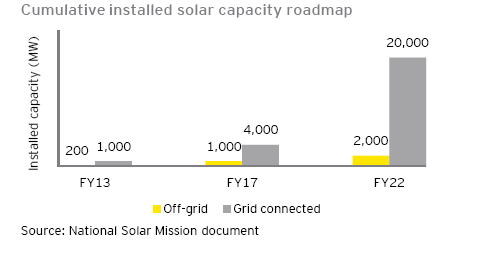
It’s been 2 years now since the launch of the Jawaharlal Nehru National Solar Mission (JNNSM) in India that sets an ambitious target of 20GW grid connected solar power by year 2022.
Read more here: Link to original article
Thursday, April 7, 2011
Thursday, March 24, 2011
This is exciting new development.
Never use a charger for your smart phone, possible?
The Sun is kind. Have faith!
Never use a charger for your smart phone, possible?
The Sun is kind. Have faith!
Tuesday, March 15, 2011
Stanford Makes Nanotechnolgy Solar Breakthrough
Chemical engineering Professor Stacey Bent first became interested in a new kind of solar technology two years ago. These solar cells used tiny particles of semiconductors called “quantum dots.” Quantum dot solar cells are cheaper to produce than traditional ones, as they can be made using simple chemical reactions. But despite their promise, they lagged well behind existing solar cells in efficiency.”I wondered if we could use our knowledge of chemistry to improve their efficiency,” Bent said. If she could do that, the reduced cost of these solar cells could lead to mass adoption of the technology. In principle, quantum dot cells can reach much higher efficiency, Bent said, because of a fundamental limitation of traditional solar cells.
Monday, March 14, 2011
SolarCity receives 40 million dollars for solar projects
SolarCity and financial services company Citi have announced a new 40 million US dollar fund to finance residential solar projects in the US this year. The funds will be used to provide homeowners with solar lease options, so they will install solar panels on their home.
More info at www.solarcity.com
Saturday, February 26, 2011
Monday, February 21, 2011
India Solar Energy Summit- New Delhi
17-18 Feb 2011
I attended this summit as Solar Novus Today representative. Was an action packed conference with some good information sharing and discussions. The networking time interspersed was also quite beneficial. The downside was however that some companies used their speaking slots to merely do a sales pitch rather than sharing knowledge and learning.
Met quite some interesting people in the field of Solar and Renewables in general.
What was striking was that there is a lot happening in India, but there is no central official tracking of facts such as: how much is installed?, what is the performance/learnings? and what is upcoming?. So there was a general feeling in the participants of the summit that there is a lot of proverbial 'darkness' in India in this field. The Ministry of New and Renewable Energy (MNRE) is expected to take some lead in dispelling this darkness.
See the account of both days of the summit at Solar Novus: Day-1 & Day-2:
Tuesday, February 8, 2011
India’s Readiness as Solar Energy Leader - Solar Novus Today
India is on the right footing but I think far for mature in terms of the value-chain capabilities to get it going. Read my article published in Solar Novus on India's readiness as a Solar leader.
This article needs a bit of Solar know-how in the background esp. the value-chain aspects.
Monday, February 7, 2011
Solar Energy- The most popular demand
Solar Energy has become the most favorable alternative as per a consumer survey done in the United States by Pike Research.
Solar Energy also had the least unfavorable score of only 4%. It also received the smallest percentage of neutral (13%) and not sure/not familiar (4%) type of response. The high levels of very favorable (52%) impressions for solar energy accross gender, income, education and age segments suggests that it enjoys a mass appeal to be the alternative technology of the future. Even older (65 or older) segments of the population had very favorable response to solar energy concept as did the younger segment and that proves that the enthusiasm is prevalent accross all generations. The research also noted that the benefits of solar energy are equally appealing to consumers regardless of their differences in energy consumption, home ownership and adoption of new technologies.
Although this survey only covers US consumers, it is noteworthy as the world's biggest economy acknowledges and embraces the merits of this technology. This acceptance is now widespread and I am sure that other parts of the world would show similar results. Its really opportune that government and organisations of all countries now wake up to this fact and start supporting efforts towards including solar in their key energy mix to ensure security of energy supply and betterment of the environment.
A full copy of the white paper is available for free download on the Pike Research website.
Friday, January 28, 2011
Solar Grandmothers and Postmen of India
Undoubtedly, Solar Power is reaching the heartlands of India in a big way very soon and there are some initiatives such as the two stories below that are really heart-warming on how Solar Power can be also used to eradicate poverty and elevate standard of living in developing countries like India.
Solar Grandmothers
Ever imagined that illiterate and old aged women from remote villages can be recruited as “solar engineers”? The Barefoot College in India trains women from around the world to install and maintain solar lighting and power in their home villages. Using sign language and color-coded circuits, the women learn to build and maintain a variety of solar lamps and chargers in a six months hands-on training course. The Barefoot College "campus" is located in Tilonia, a village in the Rajasthan state of India. The school has trained 150 grandmothers from 28 countries, electrified around 10,000 houses with solar power and saved several thousands of liters of diesel and kerosene from polluting the atmosphere. “There shall now be light, instead of darkness in our village” exclaims one of the ‘graduates’ from the school, who thinks solar energy will replace the polluting and expensive kerosene lamps that she uses now.
The campus itself is a testament to the power of solar energy as everything there is powered by the sun; food is prepared using a parabolic solar cooker, night classes are powered by solar lanterns. "We have shown that solar-electrified villages can be technically and financially self-sufficient," says Sanjit Roy the founder of Barefoot College who is fondly known as “Bunker”. The Barefoot College is an innovative bottom-up approach to rural education and development and is run as a non-profit organization with public donations and government funding.
Solar Postmen
In another story also from the state of Rajasthan in India, post delivery persons (who are mostly men in India) are chosen as beneficiaries of solar powered vehicles. Postmen in India are traditionally looked upon as iconic figures of selfless and friendly social service. They have to walk, trek or ride on bicycle for miles together in the scorching heat or pouring rains in order to deliver letters to homes in the remotest areas. There is often only a single postman delivering letters to the entire village. Their plight will now be alleviated in Ajmer in Rajasthan, which will be the first state in India to deliver postal messages through a solar powered vehicle delivery system.
Sachin Pilot, Union Telecom and IT minister of state, has inaugurated on 24th January 2011 the first solar powered rickshaw for the use of postmen to deliver the postal items. Five eco-friendly solar auto rickshaws were distributed to the postmen in different parts of the district. The state department will monitor the results of this trial and if found worthwhile, it will be spread to other parts of the country. This will certainly broaden the smile on the service-oriented and hardworking postmen of India’s postal service.
Thursday, January 27, 2011
"Solar is the answer": atleast for these villagers trained by Sanjit 'Bunker' Roy.
This is the most interesting, philanthropic and immensely contributing use of Solar Energy I've ever seen.
Kudos to "Bunker" Roy !!
Monday, January 17, 2011
Monday, January 10, 2011
Solar Energy Heroes
A list of people I admire in the Solar Energy Sector due to their outstanding contributions. Will keep on adding to this list as and when a new Hero is found!
Harish Hande
Hande co-founded SELCO INDIA (in 1995), a social enterprise, to eradicate poverty by promoting sustainable technologies in rural India. With its headquarters in Bangalore , SELCO has 25 branches in Karnataka and Gujarat. Today SELCO INDIA has installed solar lighting systems in over 120,000 households in the rural areas of these states.
Hande has won the Ashden Award for Sustainable Energy 2005 and Tech Museum Award 2005. Hande has also received the world’s leading green energy award from Prince Charles in 2005. In 2007 SELCO INDIA won the Outstanding Achievement Award from Ashden Awards. The award was presented by Al Gore, former Vice President of the United States of America. Hande was named the Social Entrepreneur of the Year 2007 by the Schwab Foundation for Social Entrepreneurship and the Nand & Jeet Khemka Foundation. He was also the featured attendee and speaker at the Clinton Global Initiative 2007.
In 2008, Hande was chosen by Business Today as one of the 21 young leaders for India’s 21st century. In mid 2008, India Today named him one of the 50 pioneers of change in India.
He was awarded with Asia's prestigious Ramon Magsaysay Award for 2011, also sometimes referred to as Asia's Nobel Prize, for “his pragmatic efforts to put solar power technology in the hands of the poor, through his social enterprise SELCO India”.
Deepak Gadhia
Deepak Gadhia is a manufacturer of Scheffler concentrators and steam cooking systems, parabolic cookers, etc. He engineered and helped create large arrays of Scheffler concentrators for institutions, one of which at Tirupati, India, solar cooks 30,000 meals per day.
Sanjit 'Bunker' Roy
Sanjit 'Bunker' Roy (born 2 August 1945) is an Indian social activist and educator. In 1972 he founded the Barefoot college in Tilonia, Rajasthan. The Indian non-governmental organization was registered as the Social Work and Research Centre. He was selected as one of Time 100, the 100 most influential personalities in the world by TIME Magazine in 2010.
Turning grandmothers into solar engineers is one of Sanjit "Bunker" Roy's favorite jobs. "Solar is the answer".."The way to go about this is not a centralized grid system, which brings in power from hundreds of miles away," he says.
"It is to bring in basic light right down to the level of basic household wherein they take ownership and control over that technology."
Women are the focus for the solar power projects that the Barefoot College runs because men "were very untrainable," says Roy.
See this interesting Video on his unusual achievement
Damian Miller - CEO, Orb Energy
Damian is a US and UK national, and is the CEO of Orb. He has 10 years experience in the solar photovoltaic industry and holds a doctorate from Cambridge in solar technology in emerging markets. After finishing his PhD in 1998 he put his research findings into practice. He joined Shell, becoming Shell Solar's Director of Rural Operations and establishin solar subsidiaries in India, Sri Lanka, the Philippines and Indonesia. He also implemented a large-scale solar project in China and managed joint ventures in Morocco and South Africa. At the end of 2006 he set up Orb Energy in India. In just two years, Orb has become one of India's leading providers of solar energy solutions. Orb sells, installs and services solar systems across multiple states in India, with plans for further expansion. Damian Miller is known for his ability to pioneer and lead new solar companies in Asia, and is the author of the recently published book Selling Solar.
Jigar Shah - CEO, Carbon War Room
A renowned visionary, Jigar Shah is committed to renewable energy and sustainable solutions that enable prosperity beyond the carbon economy. As CEO of the Carbon War Room, Jigar is dedicated to indentifying business-as-usual practices and replacing them with low-carbon solutions. Prior to the Carbon War Room, Jigar founded SunEdison in 2003. Under his leadership, SunEdison revolutionized the solar industry by introducing a business model to sell solar as a service. The transformation to solar power service agreements is responsible for turning solar services into a multi-billion dollar industry.
Jigar is also an expert on energy project finance, changing energy policy, working with entrenched stakeholders, and convincing individuals to embrace energy technology. He works closely with entrepreneurs, policymakers, and investors around the world to develop, incubate, and implement sustainable solutions that enable prosperity beyond the carbon economy.
Jigar holds a BS in Mechanical Engineering from the University of Illinois, Champaign-Urbana, and an MBA from the University of Maryland. Jigar sits on the boards of the Prometheus Institute for Sustainable Development, SB NOW, and Greenpeace USA.
Ashok Bhalotra - Director, Fews for more
Ashok Bhalotra is a visionary Indian architect and urban planner. After studying in India in the before mentioned areas, he worked in India and Kuwait. He then worked for four years in Paris at Woods & Candalis and Anatole Kopp. Since 1971 he has worked for KuiperCompagnons, Office of Planning and Architecture in Rotterdam, functioning as its director. Apart from projects in the Netherlands, he has been involved in the planning of projects abroad. He is the designer of the national airport of Dubai sheikhdom, the King Saud University in Saudi Arabia and a town hall in New Delhi.He is particularly known for the Dutch neighbourhood Kattenbroek, a residential area of over 5,000 homes in the north of Amersfoort, also known as the 'City of the Sun', a revolutionary residential area that fully incorporates solar energy.
Wednesday, December 22, 2010
Tipping Point for Solar Power in India
After attending the Intersolar Conference and Exhibition last week (14 Dec) in Mumbai (India), I truly felt that India is now on the tipping point of Solar Energy Development. Ofcourse there are some challenges, but I sincerely hope that all goes well.
My article covering some points I gathered during the conference is posted here:
> Tipping Point for Solar Power in India
I'll be posting more developments and commentary about the development of Solar Power in India, the place where the Sun 'shines' ever so brightly.
Monday, December 20, 2010
Intro to India's National Solar Mission
This is an extract from the original document to be found here.
Introduction
The National Solar Mission is a major initiative of the Government of India and State Governments to promote ecologically sustainable growth while addressing India’s energy security challenge. It will also constitute a major contribution by India to the global effort to meet the challenges of climate change.
Importance and relevance of solar energy for India
- Costs: Solar is currently high on absolute costs compared to other sources of power such as coal. The objective of the Solar Mission is to create conditions, through rapid scale-up of capacity and technological innovation to drive down costs towards grid parity. The Mission anticipates achieving grid parity by 2022 and parity with coal-based thermal power by 2030
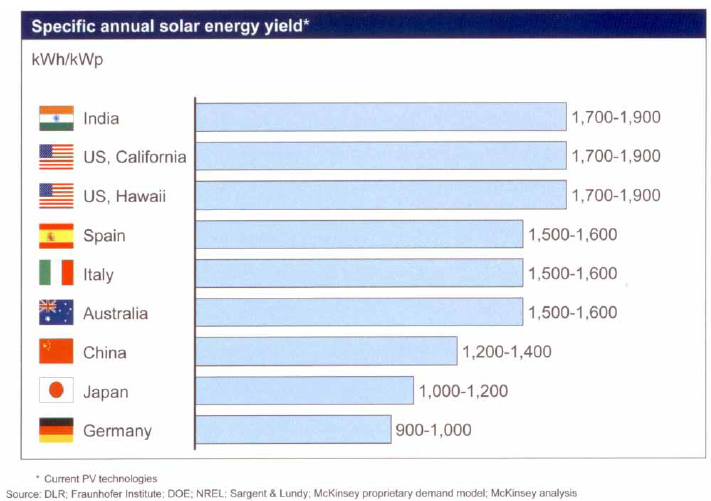
- Scalability: India is endowed with vast solar energy potential. About 5,000 trillion kWh per year energy is incident over India’s land area with most parts receiving 4-7 kWh per sq. m per day. Hence both technology routes for conversion of solar radiation into heat and electricity, namely, solar thermal and solar photovoltaics, can effectively be harnessed providing huge scalability for solar in India.
Objectives and Goals
Salient Features:
- NTPC Vidyut Vyapar Nigam (NVVN) will be the single buyer of the power produced by Independent Power Producers (IPPs) selected under the mission. It will be bought at fixed rates for 25 years. Rates will be fixed by the Central Regulatory Electricity Commission (CERC)
- Bundling of solar power with unallocated coal-based power from NTPC and selling to 'State Utilities' at a cheaper price.
- Fixing an attractive tariff of INR 17.91 for Solar PV and INR 15.31 for Solar Thermal projects that are commissioned before March 2013. Average commercial tariff rates in India are now (year 2010) around INR 8 per unit (kWh)
- Fixing up solar purchase obligations at 0.25% on total power consumption for State Electricity Boards.
- Tax holidays for 10 years, customs and excise duty concessions, an accelerated depreciation adjusting Generation Based Incentive
Read more from the original document to be found here.
Saturday, December 18, 2010
Interesting presentation on boosting Solar demand
Came across this interesting presentation that offers some pointers on boosting demand for Solar energy, although its 4 times more expensive than the alternatives. Good insights and I will probably work on these pointers all my life...
Tuesday, November 23, 2010
Solar Energy Puzzle-1
Having read the articles on 10 best things and 10 challenges for Solar Energy, its time to test your knowledge or just have some fun solving this crossword puzzle.
(follow the link to play this puzzle online or download it as pf file here)
Wednesday, November 17, 2010
10 Challenges for Solar Energy
Just as fantastic the best things sound, Solar Energy does have some challenges to overcome. Its good to know them so that work and creativity can be applied to overcome them. Focus on the best things and work on the challenges, that should get it to where it belongs.
1. The Sun's energy (heat and light) is not available at night on the Earth. The solution around has been to store the energy generated during day in batteries, which are however the weakest link in the system (poor life and efficiency)
2. Generating electricity from Solar PV (photo-voltaic) technology requires a lot of surface area and hence a lot of land. This is also tied with the fact that the commercially available Solar cells are less than 20% efficient. Lower the efficiency, bigger the land area required. In small countries like Singapore, this is a huge disadvantage.
3. Lack of good efficiency Solar cells and technologies mean that there is a lot of wastage. Hence even though the Sun is the most abundant source of energy, converting this all into electricity becomes a challenge.
4. Most of the Solar technology employed today is as good as it was 30 years ago. Over the past 30 years, no major technological breakthrough has happened in the field of Solar Energy use.
5. Solar PV cells operate better in cooler temperatures. Usually heat and sunlight go together and hence preserving the efficiency is a challenge.
6. DC electric power produced by Solar PV cells has to be converted to AC before use with conventional systems, appliances and grids.
7. Solar power system might usually mean high initial investment although the running costs are very low.
8. Solar power struggles to justify its place today using conventional economic calculations, which happily ignore the ill-effects on the environment and permanent climate change problems.
9. Researchers, scientists and engineers are divided over developing the best renewable energy source (Sun, wind, biomass, fuel cells). This diffusion of attention breeds challenge for Solar Energy, which is the simplest and single most source of eternal energy in our system. Instead of applying creativity to solve the above problems, some scientists have been busy proving their worth with complicated forms that are 'not-so-renewable' really.
10. There is a serious lack of awareness and adoption of Solar Energy at the common man's level.
Overcoming this challenges is going to be an exciting journey for the supporters of Solar Energy.
See attached commentary (listen to the audio) that puts the point across very eloquently.
1. The Sun's energy (heat and light) is not available at night on the Earth. The solution around has been to store the energy generated during day in batteries, which are however the weakest link in the system (poor life and efficiency)
2. Generating electricity from Solar PV (photo-voltaic) technology requires a lot of surface area and hence a lot of land. This is also tied with the fact that the commercially available Solar cells are less than 20% efficient. Lower the efficiency, bigger the land area required. In small countries like Singapore, this is a huge disadvantage.3. Lack of good efficiency Solar cells and technologies mean that there is a lot of wastage. Hence even though the Sun is the most abundant source of energy, converting this all into electricity becomes a challenge.
4. Most of the Solar technology employed today is as good as it was 30 years ago. Over the past 30 years, no major technological breakthrough has happened in the field of Solar Energy use.5. Solar PV cells operate better in cooler temperatures. Usually heat and sunlight go together and hence preserving the efficiency is a challenge.
6. DC electric power produced by Solar PV cells has to be converted to AC before use with conventional systems, appliances and grids.
7. Solar power system might usually mean high initial investment although the running costs are very low.8. Solar power struggles to justify its place today using conventional economic calculations, which happily ignore the ill-effects on the environment and permanent climate change problems.
9. Researchers, scientists and engineers are divided over developing the best renewable energy source (Sun, wind, biomass, fuel cells). This diffusion of attention breeds challenge for Solar Energy, which is the simplest and single most source of eternal energy in our system. Instead of applying creativity to solve the above problems, some scientists have been busy proving their worth with complicated forms that are 'not-so-renewable' really.10. There is a serious lack of awareness and adoption of Solar Energy at the common man's level.
Overcoming this challenges is going to be an exciting journey for the supporters of Solar Energy.
See attached commentary (listen to the audio) that puts the point across very eloquently.
Saturday, November 13, 2010
10 best things about Solar Energy
1. The energy from the Sun is the most abundant form of energy available. I read somewhere that in one hour, enough sunlight falls on the earth to produce energy for the entire year for the world.
2. There is a reason why its called 'renewable' or 'sustainable' energy and it is that the Sun's energy is there to stay and its not diminishing like the reserves of fossil fuel. The Sun is the star of our solar system and its suppose to meet the energy needs of all planets. Sun is source of infinite energy for our planet.
3. Production of electricity or heat from Solar energy does not lead to harmful emissions to the environment such as toxins or green-house gases that lead to global warming and other ill-effects. In fact there are almost Zero emissions during the use of Solar energy for meeting our energy needs. There is also no consumption of precious water.
4. There is no noise pollution when producing energy from the Sun (Solar PV or Solar thermal technologies). In fact there is no noise at all. No other form of renewable or non-renewable energy options can do this!
5. Production and use of Solar energy poses very little process hazards. Risks of explosion, fire and chemicals are almost non-existent. Solar energy is hence the safest and healthiest ways to produce energy.
6. Solar energy systems have very low level of maintenance requirements. As there are no moving parts, there is significantly less wear and tear and hence solar panels or heaters are long-lasting (20-30 years).
7. Solar energy production has very low running costs. Once installed, production of energy is almost 'free' for the lifetime of the system.
8. Solar energy systems can be independently installed in remote locations. There are more than 1 billion people in the world without electricity connection and just imagine the wonders possible with an independent system in a very remote location where the Sun always shines.
9. The costs, emissions, safety, security and dependency over the entire supply-chain of energy production and use are very low. Compare that to transporting conventional source of fuel from one place to another. Also independent installation means that the high voltage electrical transmission cables can be avoided to a great extent.
10. There is a tremendous scope for research, development and implementation of Solar Energy in the world, especially in countries that are in the so-called sunny belt. This also has social implications such as job creation and socio-economic development and awakening to a very sustainable energy future. Take the example of China, where Solar energy adoption has grown by leaps and bounds over just few years.
With these solid benefits, Solar energy does definitely seem like the best form of energy to be pursued for meeting future energy needs. But of course there are challenges, which we will look at in the next forthcoming article in this blog post.
- Nilesh Jadhav
Subscribe to:
Posts (Atom)